

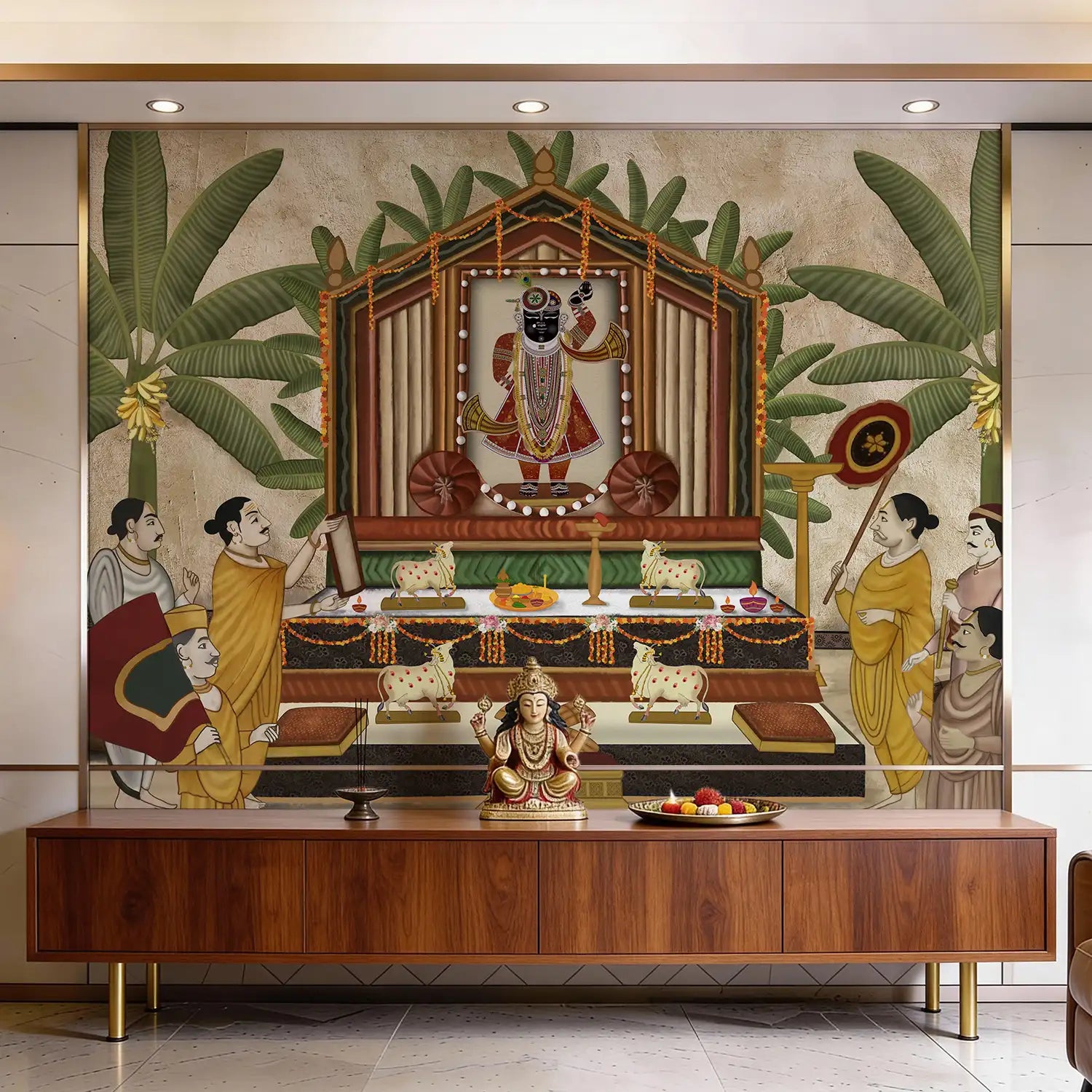
In the lanes of Nathdwara in Rajasthan, there is a particular smell by late afternoon — turmeric, limewash, slow cow-dung primer drying in the sun. The old town sits below the Shrinathji temple, and the painters live in a cluster of whitewashed houses with open courtyards.
A senior painter — someone whose grandfather painted the cloths carried inside the sanctum — sits cross-legged with a piece of rough cotton stretched on a wooden frame. He is grinding a stone of lapis lazuli against a pestle. Pichwai, the devotional cloth art made in this town for close to four hundred years, starts here: a pigment ground from mineral rock, a cloth treated with cow dung, a brush of squirrel hair, and a composition held in the painter's head from the training of his father and his father's father.
Five thousand miles west, in a townhouse in Edison, New Jersey, the same composition is going up on the wall of a pooja room.
The tradition that began behind the idol
Pichwai — the word means at the back — was made to hang behind the Shrinathji idol at the Nathdwara temple. The painting changed with the season and the festival. In spring, floral Pichwai. In the monsoon, cloud-and-peacock Pichwai. During Janmashtami, Krishna-Leela compositions with gopis and cows. The temple had a working calendar of perhaps forty compositions that cycled through the year, each painted on cotton by hand, each used for a specific week or month, then retired and replaced.
This was the original function. Four hundred years on, the art has moved beyond the temple — into homes across Rajasthan first, then Gujarat (Vaishnav families hold strong to Shrinathji imagery), then Mumbai collectors, then global collectors. Museum holdings now sit in the Victoria and Albert Museum in London and the National Museum in Delhi.
The painting itself is still done in Nathdwara, still by painters who trained under their fathers. The pigments have been updated in some workshops — acrylics now share the table with mineral paints — but the compositional logic is unchanged: Shrinathji at the centre, cows arranged radially, the Govardhan hill hovering behind, lotuses at the base.
The other Indian art forms that travelled first
Pichwai is not the only Indian tradition with an overseas history. Madhubani moved by migration — as Bihari women shifted for work in the 1970s and 80s, the folk art went with them, first to Delhi and Calcutta, then to the West. Kalamkari had a head start of several centuries: the dyed cotton panels of Machilipatnam were a major Coromandel trade good to Persia and Europe by the 1600s, quietly seeding the floral vocabulary of later Persian and French chintz.
Mughal miniature, never made for travel, nonetheless left India through colonial collections — manuscript pages from Akbar's reign found their way into Windsor and the East India House long before Indian collectors claimed them back. Each of these art forms has, in its own way, already been abroad.
What's new is that they are now arriving as wall, not as fragment. Not an album page in a museum case. Not a framed print above a sofa. A full-wall Pichwai. A six-foot Madhubani. A Kalamkari tree of life running floor to ceiling. The scale these designs were originally made for, finally available in the rooms of the diaspora that remembers them.
What happens when the wall arrives
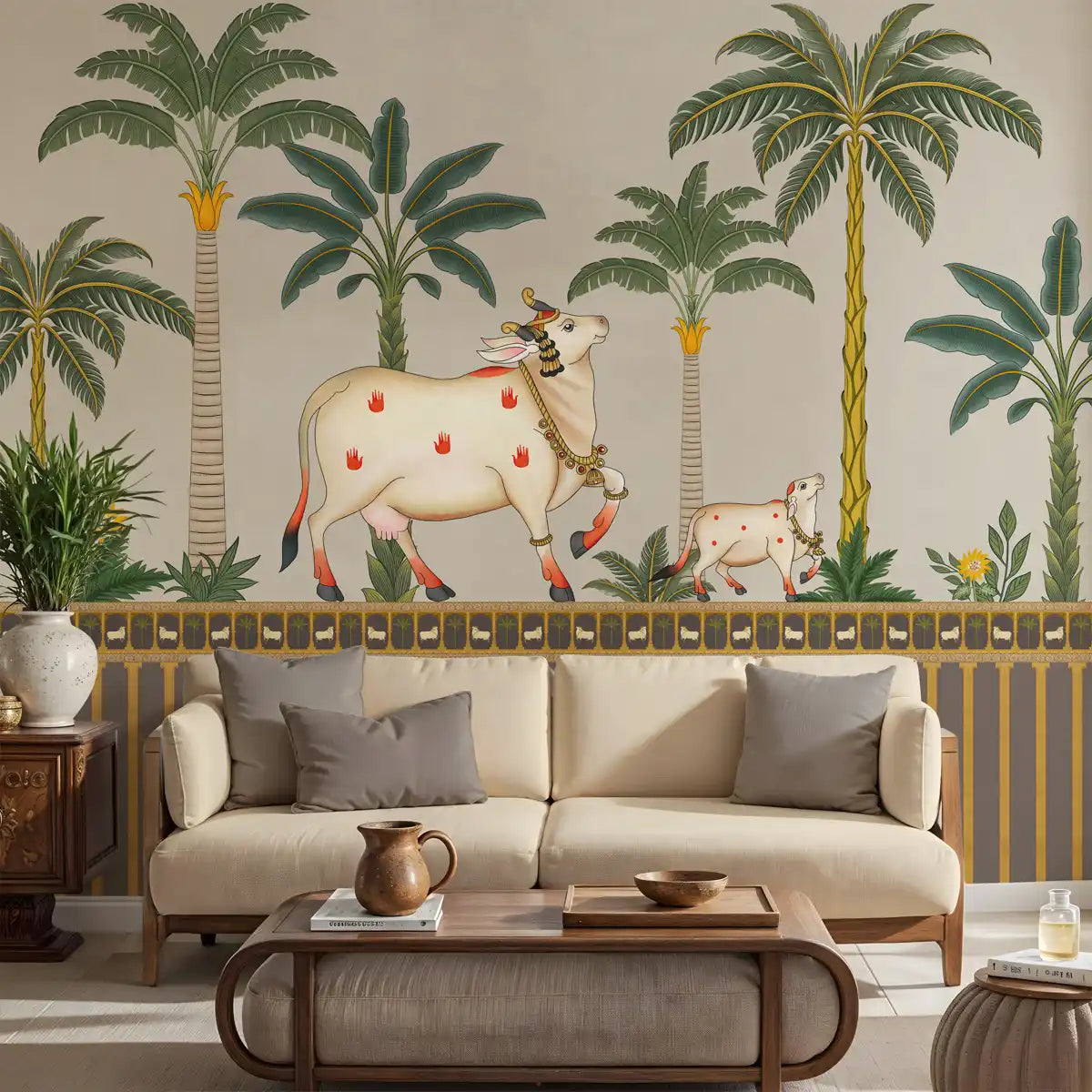
In the New Jersey townhouse, the pooja room is a converted half-bath. The owner has pulled out the sink, carpeted the floor, and set up a small marble shelf for idols. The back wall was plain cream until last month. Now it holds a Pichwai Shrinathji composition — sacred cows in procession, Shrinathji at the centre, the Govardhan hill in the background in ochre and sage. The wallcovering is designed at the studio in India, digitally printed to the wall's measurements, shipped to Edison, hung by a local wallpaper installer the owner found on Yelp.
The effect in the room is not incremental. The converted half-bath is no longer a converted half-bath. It is a pooja room in the way the owner's grandmother's pooja room was — a room whose walls know what the room is for. The aunties who come for the housewarming will stop at the door before entering. The cows will carry the room the way they were meant to.
This is the thing Pichwai has done in Indian homes for four hundred years, and the thing it now does in American ones. The distance, it turns out, was never the hard part.
The forty compositions, still cycling
Life n Colors has been working on this bridge for over a decade from a studio in India — designing wallcoverings across the major Indian traditions, Pichwai foremost among them, and shipping them to homes worldwide. The full Indian traditional wallpaper collection holds close to 250 designs.
On the Pichwai line alone, there are forty compositions — sacred cows on cream, chevron Pichwai, tree-of-life Pichwai, Krishna-Leela Pichwai, each in multiple colourways. A tree-of-life Pichwai in deep green reads more boldly. The Shrinathji in cream goes quieter. The painters who composed the originals in 17th-century Nathdwara worked to a temple calendar. The families ordering them now, in Edison and Sunnyvale and Sugar Land, work to Diwali, Janmashtami, and the month the parents are visiting from India.
Some arrangements, it seems, do not change across four hundred years. They just change address.
The line is still the same line
The painter in Nathdwara is still grinding his lapis lazuli. The pigment, once mixed, will find its way to a cloth, to a frame, to a sanctum, to a photograph, to a design file, to a printer, to a roll, to a wall, to a pooja room in Edison, New Jersey.
There are more steps in the passage now than there used to be. The line is longer. But it is still the same line. And the wall, at the end of it, is still a Pichwai.
The distance, it turns out, was never the hard part.
Practical notes for homes in the U.S.
Shipping to all 50 states, in steady volume for over a decade. Wallpapers ship pre-panelised — any American wallpaper installer can hang them with standard paste, no specialist tools. Surface wipes clean with a damp cloth; no re-coat, no fade.
Samples ship to U.S. addresses before the full order, so you can see the print in your own room's light. Message the design team on WhatsApp — they overlap with U.S. morning hours. Or call +91 93108 45706.