

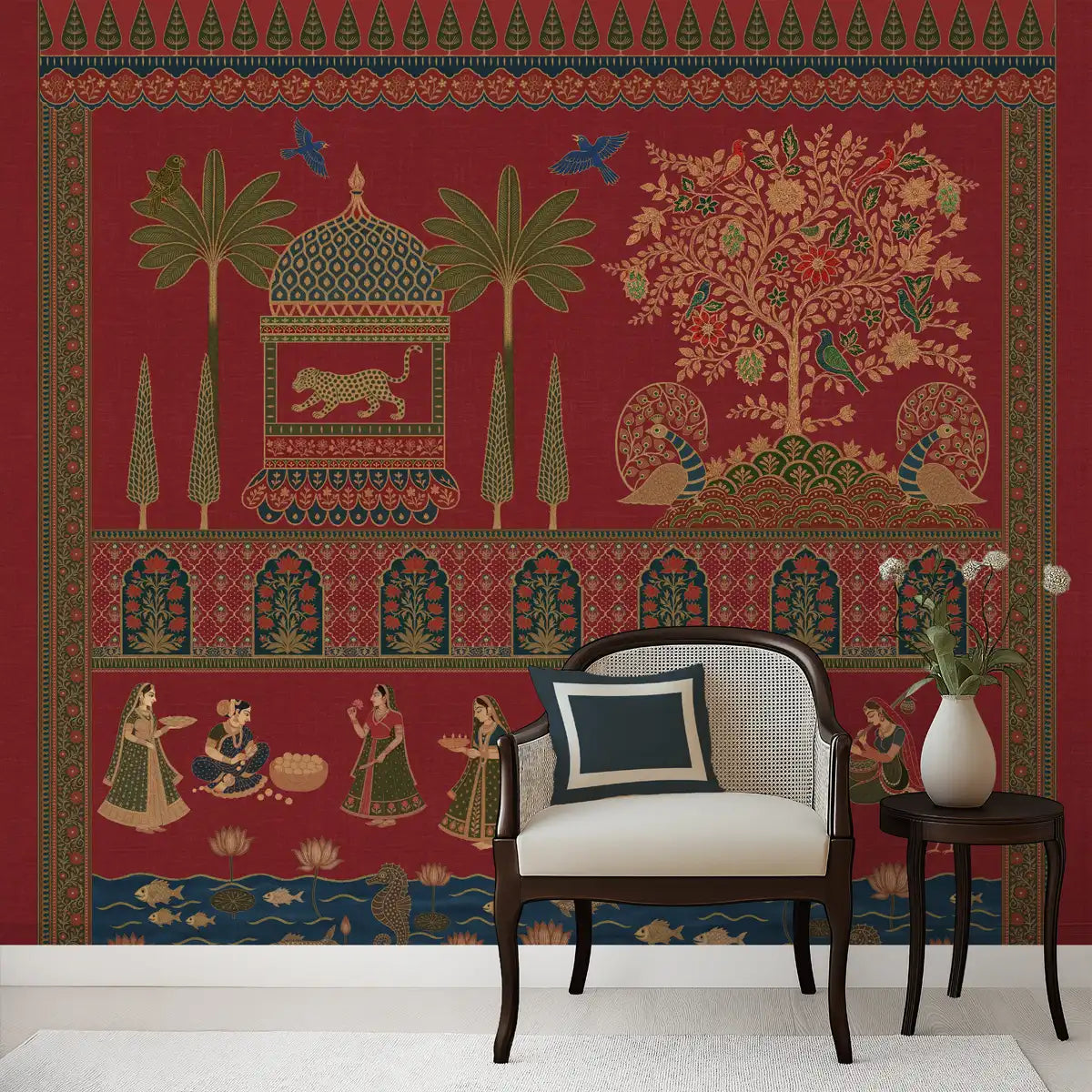
Chintz, the cotton printed in 17th-century Masulipatnam, made it to Versailles before it made it to London. Kashmir shawls sat on the shoulders of Napoleon's Joséphine decades before they became a British obsession. Paisley was woven in Kashmiri looms for six hundred years before a Scottish mill town put its own name on it. Indian taste has been travelling for as long as there have been ships willing to carry it.
What's new, in the last two decades, is that the Indian house — the room itself, the walls that held it together — has started to travel too. Not as a motif absorbed into someone else's vocabulary. Not as a souvenir in a suitcase. As a room. Built to American square-footage, heated by American winters, but governed by the walls of a place much further east.
What arrives now is not a cushion — it's a wall
The early NRI house in America, from the 1970s onward, borrowed Indianness in pieces. A Ganesha on the mantle. A brass lota repurposed as a vase. A framed Madhubani print on a study wall. These fragments worked — they were the maximum a family arriving on a work visa could carry across in luggage and in heart. They signalled the house was ours without quite being ours.
The second-generation house, and increasingly the renovated house of families who've been in America for thirty years now, moves differently. The fragments remain, but the walls start to ask for more. A Pichwai the full height of a pooja corner. A Mughal jharokha behind the dining table. A Kalamkari tree of life running from floor to ceiling in the foyer. This is not decoration. This is a register change — the Indian house speaking in its own grammar, not in borrowed English.
What makes a wall read Indian
The motif is the obvious answer — peacock, jharokha, tree of life, sacred cow. But the motif alone is not enough. A peacock on a mass-market Western wallpaper reads as pattern. A peacock in a Pichwai composition reads as devotion. The difference is in the grammar around the motif — the composition, the register, the way the wall sits in its room.
An Indian wall, historically, was organised around a single governing image. A Pichwai temple cloth held Shrinathji at the centre, with cows and worshippers arranged around him in radial order. A Mughal jharokha placed the arched window as the one moment of architectural theatre on the wall, with floral borders quietening around it. A Madhubani panel told a story in which every figure was given equal weight, because every figure carried narrative.
American walls, by default, don't do this. They hold multiple framed images at distance, or a single neutral pattern. It is not a worse convention — just a different one. When an Indian wall enters an American room, it is not replacing something. It is introducing a logic the room did not have before.
The traditions that travel best
Six Indian art forms make the crossing most confidently. Pichwai from Nathdwara in Rajasthan — four centuries of temple cloth painting, devotional and warm. Mughal miniature from the Delhi-Agra-Lahore corridor — the ornamental language of the 16th-to-18th-century court, catalogued extensively in The Met's South Asian collection. Madhubani, from the Mithila region of Bihar — folk drawings made originally by women on the inner walls of their homes for festivals, now one of the most recognisable Indian visual vocabularies.
Kalamkari from Machilipatnam and Srikalahasti in Andhra — pen-drawn cotton work with the tree of life as its signature composition, once a major Coromandel trade good to Persia and Europe. Rajasthani miniature — Mewar, Marwar, Bundi courts — gives you royal procession and scenic landscape. South Indian mural from Kerala and Tamil Nadu brings gopuram temples, palms, and the cobalt-and-vermilion palette of the southwest coast.

Where these walls settle, once the house is abroad
An Indian wall, in an American home, doesn't usually wrap a whole room. The compositions are too dense; the art was never meant for it. What it does — almost always — is hold one feature wall.
In the foyer, a Kalamkari tree of life or a Mughal jharokha is the first announcement the house makes. This is the move in most two-storey East Coast homes, where the foyer wall runs tall and is seen before anything else. In open-plan California and Texas houses, the move is usually behind the dining table, where ceiling drops to eight or nine feet and the eye rests on the one wall not carrying kitchen or sliding door.
The pooja room is almost always the second decision, and here Pichwai does most of the work. A Shrinathji composition or a Krishna-Leela panel carries the devotional register these rooms need, without asking for an elaborate mandir build-out. Primary bedrooms take more carefully — headboards wall-mounted with Mughal or Kerala mural designs read warm, but only if palette-matched to the room. Children's rooms go comfortably to Rajasthani and folk — peacocks, elephants, the storytelling register.
The studio behind these walls
Life n Colors has been designing Indian wallcoverings for over a decade, from a studio in India, shipping to homes across the U.S. — East Coast townhouses, Bay Area condos, Midwest suburban builds, Hill Country ranch houses. The wallpapers are designed and digitally printed to the exact dimensions of your wall. The Anant Vriksha Kalamkari reads directly from the Srikalahasti tradition. The Lotus of Kailasa draws on the Kerala mural canon. The full Indian traditional wallpaper range holds close to 250 designs across all six traditions above.
A single conversation over WhatsApp, a sample shipped to the U.S. address, a wall measured and panelled, a local wallpaper hanger standard to any American install. That is the quiet logistics behind the house arriving abroad.
The house was always capable of travel
What's ending isn't the notion that Indian homes stay in India — that idea was never quite true, anyway. Chintz, shawl, paisley, miniature painting: Indian design has been arriving in foreign rooms for four hundred years.
What's ending is the pause between the family crossing and the house crossing. That gap used to be two generations long — the first generation keeping the fragments, the second building the full room. Now it's the time it takes to get a wall measured.
The Indian house was always capable of travel. It was just waiting for a wall willing to hold it.
Practical notes for homes in the U.S.
Shipping to all 50 states, in steady volume for over a decade. Wallpapers ship pre-panelised — any American wallpaper installer can hang them with standard paste, no specialist tools. Surface wipes clean with a damp cloth; no re-coat, no fade.
Samples ship to U.S. addresses before the full order, so you can see the print in your own room's light. Message the design team on WhatsApp — they overlap with U.S. morning hours. Or call +91 93108 45706.