


The wall across from table seven does most of the work in any restaurant. A guest sits in front of it for forty-five minutes on a weeknight, two hours on a weekend. In a home, a wall gets a glance. In a restaurant, it becomes the backdrop to the whole evening — the thing people photograph, argue about, and remember long after they've forgotten what they ordered. That is a different brief from any other interior project, and it calls for a different kind of thinking.
Restaurant and café wallpaper is not a finishing touch. It is a design decision with as much bearing on the space as the lighting or the seating layout — and it is, very often, the element that makes a room feel considered rather than assembled. Getting it right starts not with which design looks good, but with what the wall needs to say.
Before you pick a design: what the wall needs to do
The first question is not aesthetic. It is conceptual. What is this restaurant's story, and does the wall tell it? A North Indian heritage dining room with brass cutlery and hand-blocked menus is pointing toward a different visual register than a bright all-day café with natural light and cold brew. The wall should come from the same source as the concept — not decorate it from a distance.
A few decisions bring the brief into focus:
Cuisine and concept alignment. Mughal scenic murals read naturally in formal North Indian dining rooms. Kalamkari — the ancient Andhra art of narrative drawing — suits South Indian and vegetarian restaurants; its flat, linear compositions settle comfortably against warm wood and terracotta. Kalamkari's visual language, developed over centuries for temple cloth and storytelling panels, has the same narrative pull on a restaurant wall that it had in its original context: you read it slowly and find something new each time. Pichwai, with its devotional cows and lotus pools, has a contemplative quality suited to quieter Indian fine dining. Tropical murals open coastal and Kerala-themed spaces. Mediterranean archway murals give European cafés and brunch restaurants the architectural scale that real renovation rarely can.
Wall position and viewing distance. A wall behind the bar needs to hold at a distance, across the room, under low light — bold motifs and high contrast work here. A feature wall beside a banquette is seen from close up for long periods; finer, more layered work earns that placement. A full-length dining room wall is read in sections as guests shift their gaze — continuous scenic murals, not pattern repeats, are built for this.
Lighting type. Warm amber restaurant lighting deepens dark backgrounds — navy, forest green, deep ochre — and makes them feel considered rather than heavy. Natural-lit café spaces handle lighter grounds and softer palettes better. This is the single variable that most changes which design reads well in a given room.
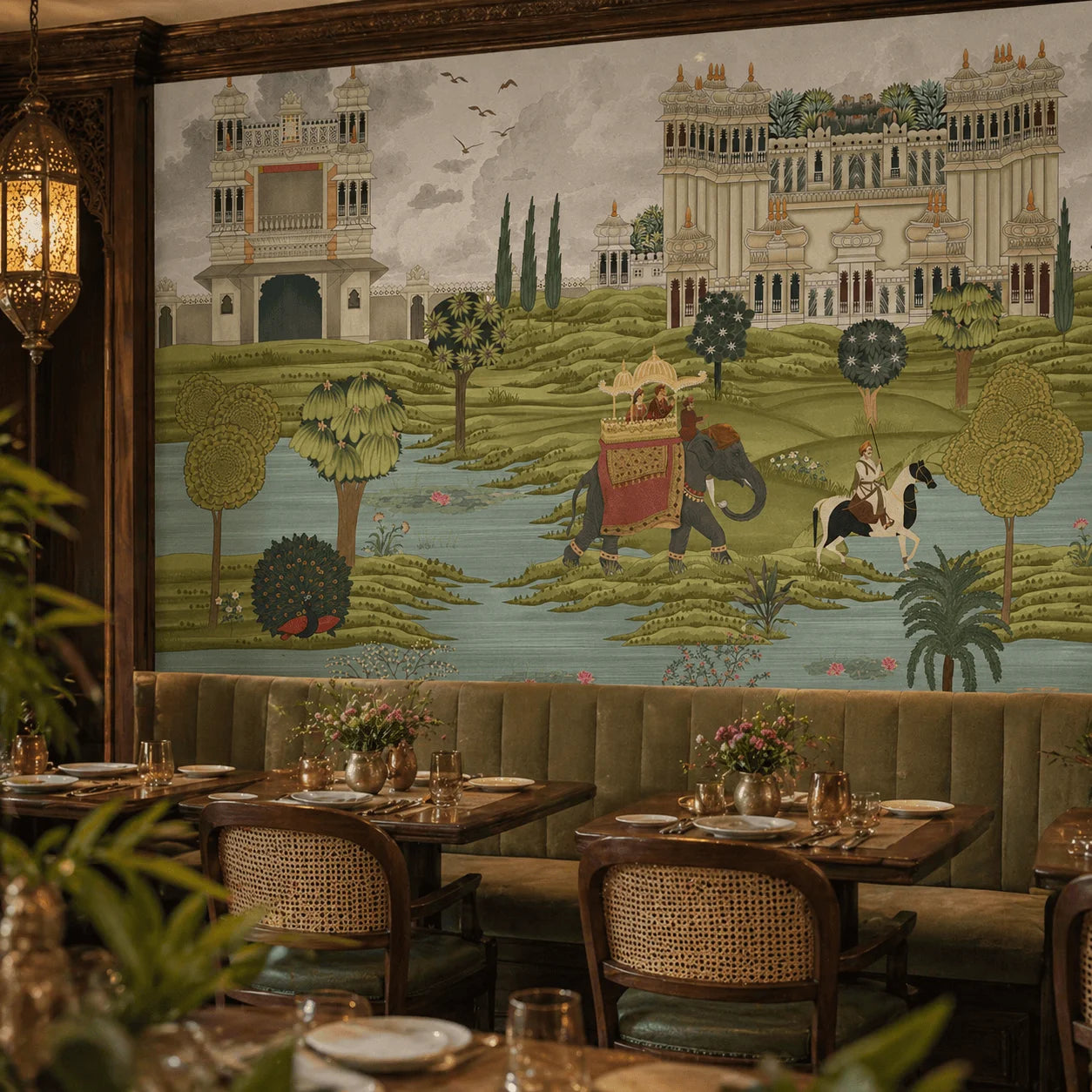 Bharat — Mughal scenic mural. Designed for formal dining rooms with height and warm amber light.
Why custom murals work in commercial spaces — and pattern repeats often don't
A repeat-pattern wallpaper is designed to tile across any wall. A mural is designed for a specific wall. In a restaurant, that distinction matters more than it does anywhere else.
Commercial walls have constraints that residential rooms rarely do: service doors, structural columns, light switches mid-wall, windows at odd intervals. A tiled pattern has to navigate all of this — and it rarely does gracefully. A custom mural is composed with the full wall dimensions accounted for: the motifs are placed where they land with the most weight, the scale of the design is adjusted to the ceiling height, and no repeat breaks awkwardly at a frame or corner.
Scale is the other reason. A restaurant dining room at twelve feet needs entirely different treatment from the same design at nine feet. Custom sizing means the artwork fills the wall as the composition was intended — not stretched, not cut, not repeated past the point of meaning.
All designs in Life n Colors' restaurant and café wallpaper collection are custom-sized to the exact wall. There are no fixed rolls, no standard widths. The design is fitted to the space.
 Anant Vriksha — Kalamkari Tree of Life. Designed from the centuries-old Andhra narrative drawing tradition. Works with warm wood tones and ambient lighting.
Designs from the collection — in restaurant settings
Every design below was photographed in a restaurant or café setting. The mockups show each mural at commercial scale — not in a showroom, but in actual dining rooms. These are not renders; they are the same designs, the same compositions, at the wall sizes where they are typically installed.


The range also includes Malabar — a Kerala tropical mural with dense foliage and warm greens, suited to coastal and South Indian restaurant concepts — Dastaan, a Mughal-Turkish scenic for fusion dining rooms, and Madhuban, an Indian floral in pink that softens café interiors without losing visual weight. The Nizam in clay beige offers the same architectural scale as its darker counterpart but reads more warmly in rooms with natural light.
 Nizam in clay beige — the same composition as the dark Nizam, at a lighter, warmer register. Works in naturally lit dining rooms and café interiors.
The practical brief: what to have ready before ordering
Getting a restaurant wallpaper right takes three pieces of information: the wall dimensions (height × width, in feet), the lighting type (natural, warm ambient, or cool white LED), and a clear sense of the restaurant's design concept — a moodboard or two reference images. With those three, the right design usually narrows to two or three options rather than twelve.
All designs from the commercial wallpaper range are custom-sized to exact wall measurements and printed as a single continuous mural — not panels that have to be seam-matched on site. The process starts with a consultation: share dimensions and concept direction, and the team confirms sizing, orientation, and any colour adjustments before going to print. Lead time for commercial installations is typically three to four weeks from design confirmation.
For larger restaurant projects — multiple feature walls or a full-room treatment — a staged consultation is available through the commercial design team at Life n Colors, with pricing based on final wall square footage.
The guests at the corner banquette will sit with that mural for two hours. If it was put together with intention — the right tradition for the concept, the right scale for the room, the right palette for the light — they will feel it, even if they never articulate why. That is what makes the decision worth taking seriously from the start.
All designs custom-sized to your wall. Shipped to 28+ countries.
Browse the Restaurant & Café Wallpaper Collection →