

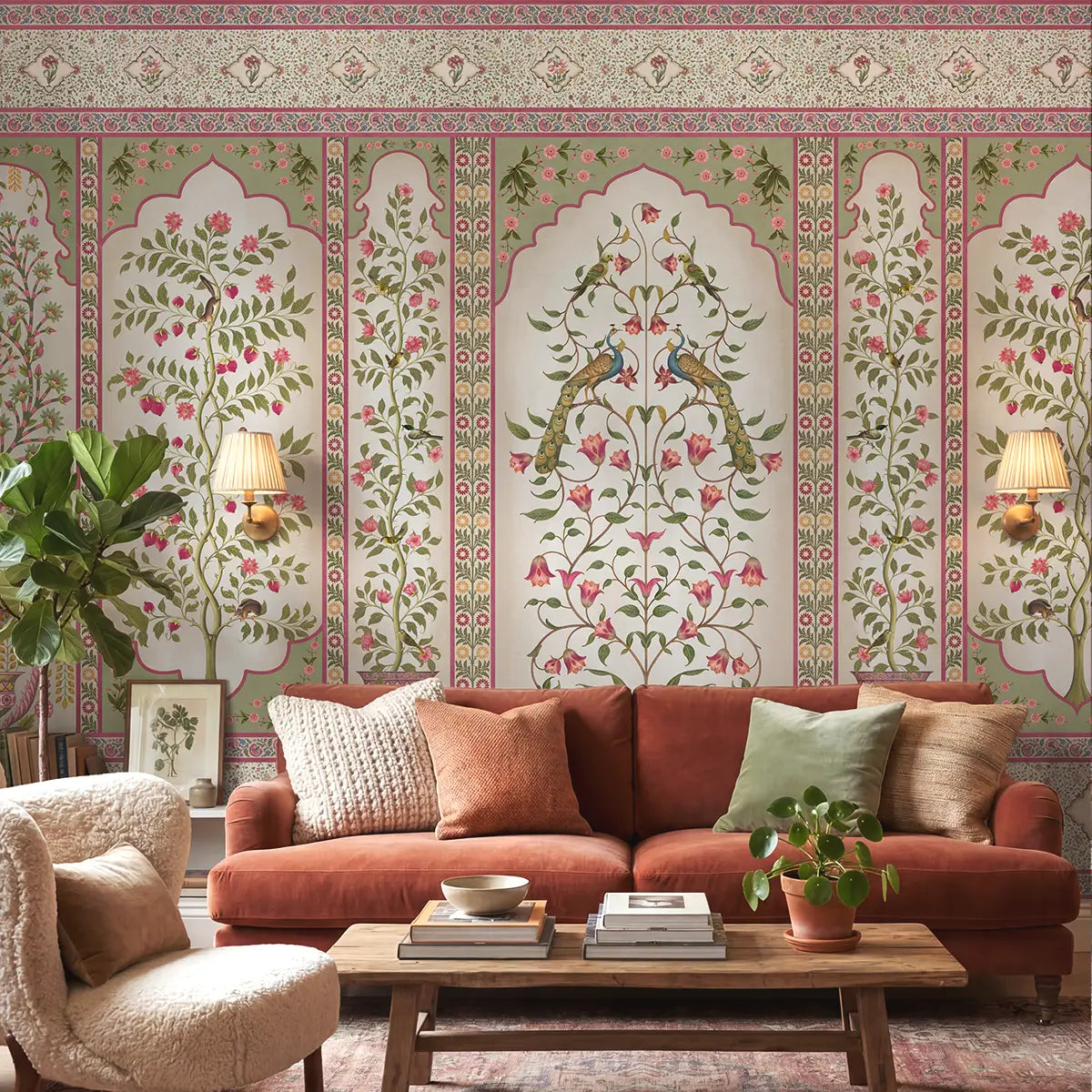
Look at any newer American house — a tract home in Irving, a condo in Jersey City, a converted rowhouse in Philadelphia. The walls are a particular kind of quiet: matte white, eggshell off-white, one accent in navy or forest. They are engineered to stay out of the way of the furniture and the framed photographs. They are, as a convention, empty.
Now look at a haveli in Udaipur, a Chettinad house in Karaikudi, a North Kolkata flat in a subdivided old building. The walls are doing the opposite of staying out of the way. A Pichwai cloth fills a full corner. A Tanjore painting holds a niche. A border of hand-drawn flowers runs above every doorway. The walls are the room, and the furniture defers to them.
Neither convention is wrong. But they are not the same convention. And when you grow up in one and live in the other, the gap between them is not a neutral space.
What Indian walls are actually doing
An Indian wall, across most regional traditions, is a narrative surface. It carries story, devotion, or a specific cultural motif, and the rest of the room composes around it. The sofa doesn't lead. The dining table doesn't lead. The wall leads.
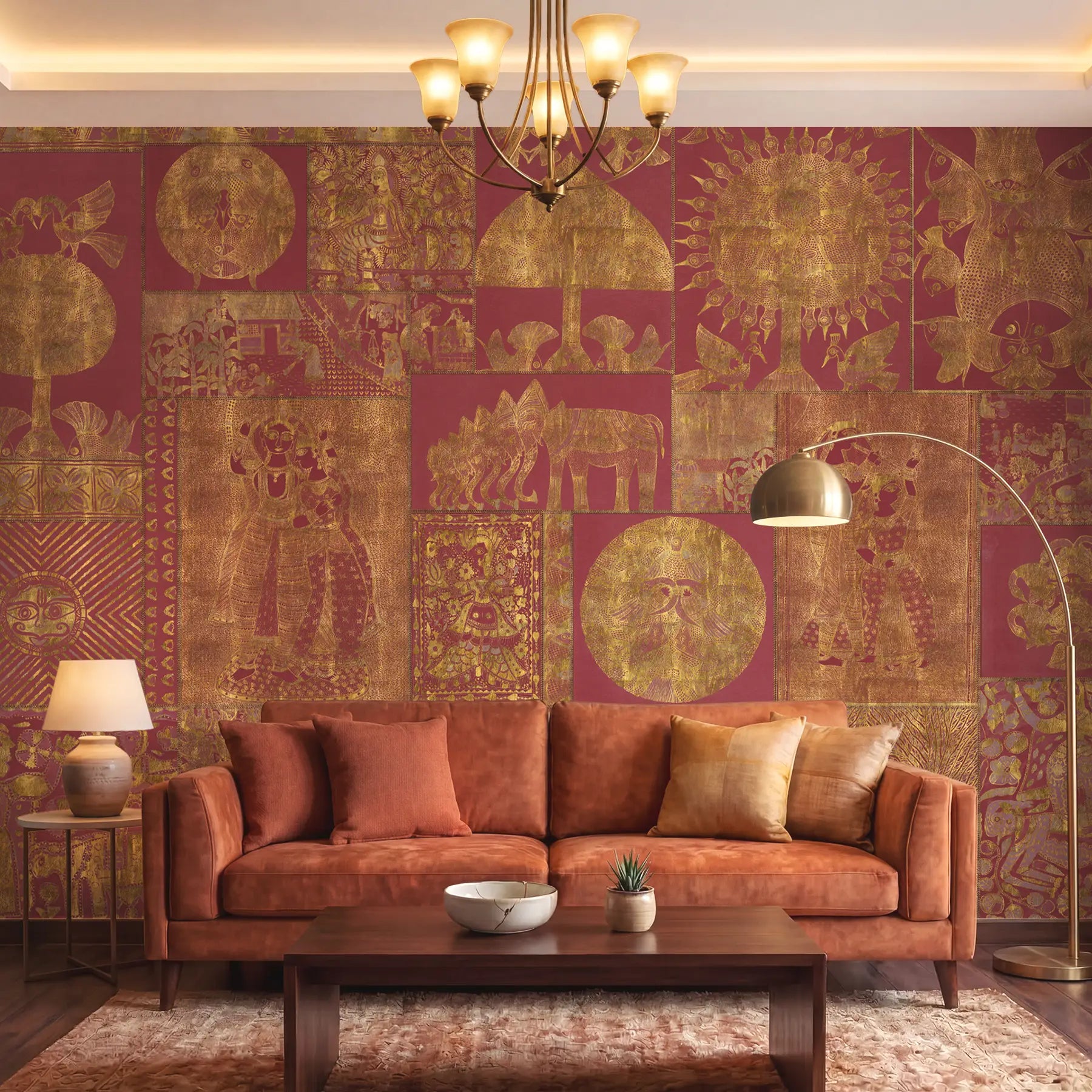
Pichwai, from Nathdwara in Rajasthan, carries devotion — Shrinathji, the cows of Vrindavan, monsoon compositions. Four hundred years of temple-adjacent painting practice. Madhubani, from the Mithila region of Bihar, carries story — weddings, harvests, deities, each figure given equal visual weight in a tight symmetrical grammar. Originally painted by women on the inner walls of their homes for festivals.
Mughal miniature, from the 16th-to-18th-century Delhi-Agra-Lahore ateliers, carries the ornamental language of the court — jharokha windows, arched pavilions, bird-and-branch compositions, floral borders. Extensively catalogued in The Met's South Asian collection. Kalamkari from Andhra carries the tree-of-life tradition, pen-drawn on cotton for five centuries. Rajasthani miniature carries scenic and courtly scenes — Mewar processions, Marwar landscapes. South Indian mural from Kerala and Tamil Nadu carries the palm-and-backwater language of the southwest coast.
Each tradition is specific to its place, its century, its training lineage. But each shares one structural principle: the wall carries the room.
What American addresses offer them
American houses, as a built form, are different from Indian houses. But in some ways they are well suited to Indian walls. Worth spelling out, because the assumption usually runs the other way.
American homes have higher ceilings than most older Indian homes. Eight to nine feet in a modest American townhouse exceeds the seven-to-eight of many older Indian apartments. An Indian wallpaper designed at full height was often working against Indian ceiling limits. In American rooms, it has more headroom to breathe.
American floor plans are more open. The single feature wall is a natural fit — open-plan living and dining rooms need a visual anchor, and an Indian wallpaper does that job without needing furniture to crowd against it. Indian houses of earlier generations were more partitioned; a full Pichwai or Mughal jharokha sometimes had to compete with doorways and pillars. The open plan resolves this cleanly.
American walls are, generally, better prepared. Drywall over wood studs, primed and skimmed, offers a more consistent substrate than older lime-over-brick builds. Wallpaper adheres and finishes cleanly. Installation is well-understood trade work — any American wallpaper hanger can do the job with standard paste.
None of this is an argument for better or worse. It's an argument for well-matched.
Where the match lives, room by room
The foyer is usually the first call. A Madhubani tree of life or a Mughal jharokha at the entry wall sets the register of the house before a guest has stepped into the living room. The Madhuban in pink, with its arched window and peacocks, is a common move — warm without going ornate.
The dining wall is the second. Most American homes run the dining against a single uninterrupted wall, and this is where large-format Indian designs — Kalamkari, Rajasthani scenic, Mughal miniature — have the room they need. Ceiling heights of eight to nine feet take the full composition without cropping.
The pooja room, where there is one, is the most considered decision. A Pichwai or a Krishna-Leela composition gives the room its devotional register without any of the overbuilt mandir hardware. Primary bedrooms take the palette-quieter designs — Geet Madhubani in clay beige, a Mughal jharokha behind the headboard. Kids' rooms open comfortably to the storytelling traditions — peacocks, elephants, Kerala murals. A Rajasthani scenic like Jodhpur suits a study or home office well, where the architectural detail adds weight without competing with a desk.
The bridge, practically
Life n Colors designs these walls from a studio in India and has been shipping them to American homes for over a decade. Close to 250 designs live in the Indian traditional wallpaper collection, across all six traditions above. Each panel is printed to the exact dimensions of your wall — you send the measurements, the panels come numbered and ready to hang.
The install side is standard American wallpaper trade — paste, smoother, trim to the edge. No specialist tool. A wallpaper installer on Thumbtack or Yelp can hang any panel the same way they would hang a Farrow & Ball or a Thibaut. The surface wipes clean. Diwali diyas, summer humidity, the monsoon-in-Boston that is September — none of this affects the print. Samples ship to U.S. addresses in about a week, so the design can be tested in the actual room's light before the full order.
The address is American. The wall doesn't have to be.
The Indian wall doesn't ask the American address to become something it isn't. The four-bedroom in Irving stays a four-bedroom in Irving. The condo in Jersey City stays a condo in Jersey City. What changes is that one wall of it — the one that greets the guest, or holds the diya, or faces the bed — now carries the longer story the rest of the house didn't get around to telling.
A house only needs one wall to start speaking a different language.
Practical notes for homes in the U.S.
Shipping to all 50 states, in steady volume for over a decade. Wallpapers ship pre-panelised — any American wallpaper installer can hang them with standard paste, no specialist tools. Surface wipes clean with a damp cloth; no re-coat, no fade.
Samples ship to U.S. addresses before the full order, so you can see the print in your own room's light. Message the design team on WhatsApp — they overlap with U.S. morning hours. Or call +91 93108 45706.