

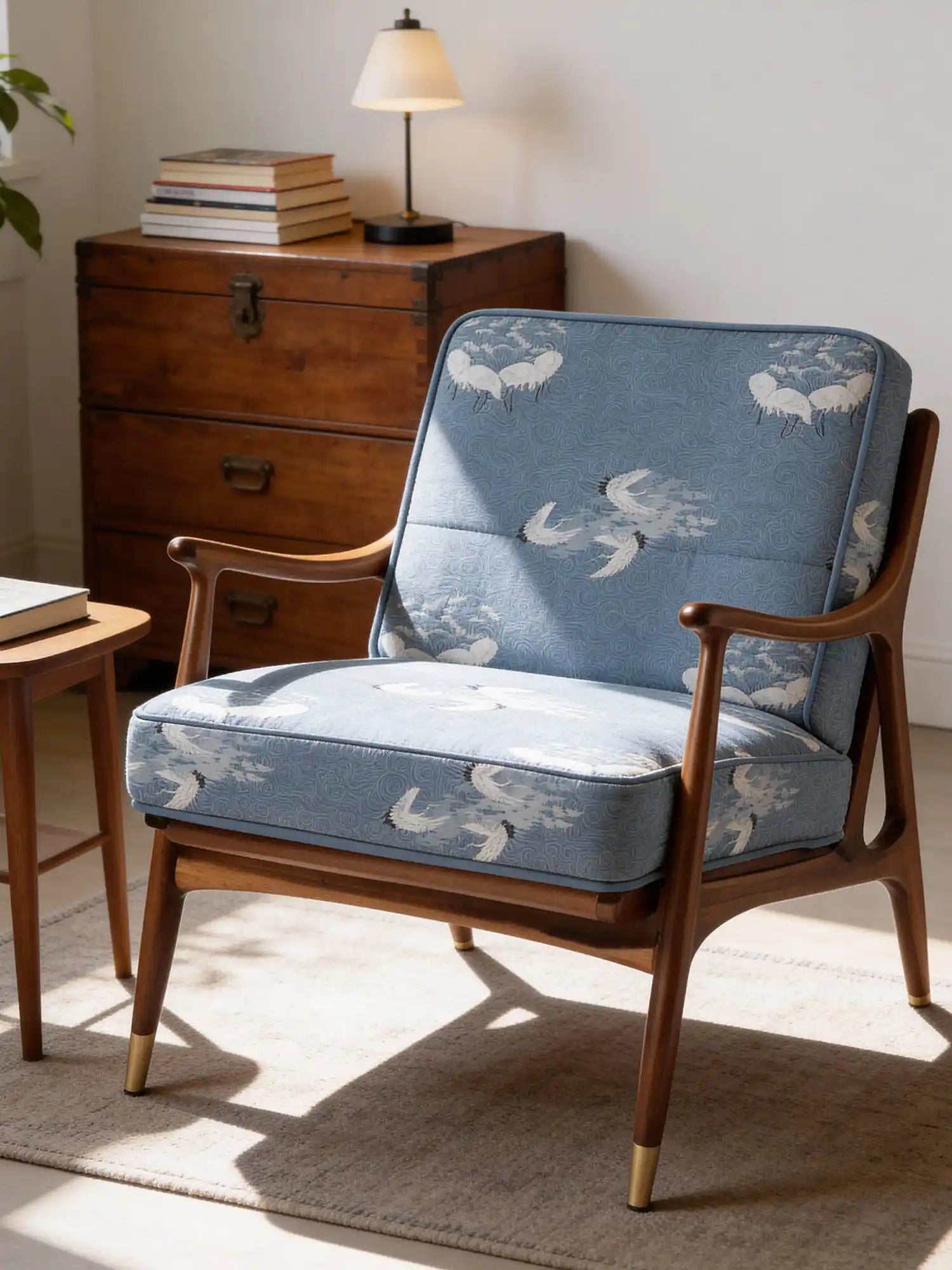
Most sofas in Indian homes wear one of four colours. Greige. Charcoal. Taupe. Navy. Safe choices, every one of them. And the result, in almost every room, is the same: a space that looks furnished but feels empty. The largest surface of fabric in the room — your sofa — is contributing nothing.
Choosing a printed upholstery fabric for your sofa doesn't mean choosing something loud. It means choosing something specific. The prints that do this work best are drawn from real design traditions: Indian folk art, Mughal floral language, Chinoiserie, Rajasthani craft, European tapestry. Stories that were worth telling long before anyone called them interior décor. Life n Colors' sofa and chair fabric collection is built around 69 of these prints — art-inspired designs that turn the plainest frame into the most considered thing in your room.
Why a plain sofa is the most expensive mistake in the room
A sofa is not a background object. It sits at the centre of the living room and holds your eye from the moment you walk in. Most people spend months selecting everything else — the rug, the artwork, the lights — and then cover the biggest piece of furniture in plain linen because they're worried the pattern will be too much.
What actually happens is the opposite. A patterned fabric anchors the room. It gives the eye somewhere to land and somewhere to travel. The plain wall behind it — far from competing — becomes the breathing space that lets the print read clearly. A well-chosen printed upholstery fabric doesn't fight the room. It finishes it.
The practical case holds too. Art-led prints age differently from plain fabric. A woven-look grey shows every crease, every dust mark, every shift in the nap. A print with visual complexity absorbs those changes — the pattern does what the plain fabric cannot.
Indian folk and classical traditions — three art forms, one piece of furniture
The pattern carries meaning. That's the whole point.
Phulkari is a needlework tradition from Punjab — women's work, passed between generations, the word translating simply as "flower work." A full bhag phulkari covered the base cloth so completely in silk thread that the weave disappeared behind the pattern. The geometry was not decorative shorthand. It recorded community, season, and occasion in colour and form. The Phulkari upholstery fabric in cream draws from this language — the dense geometric repeat, the warmth of the palette — scaled to a linen ground and built for a chair or sofa rather than a shawl. It's the same visual argument. Just on different furniture.
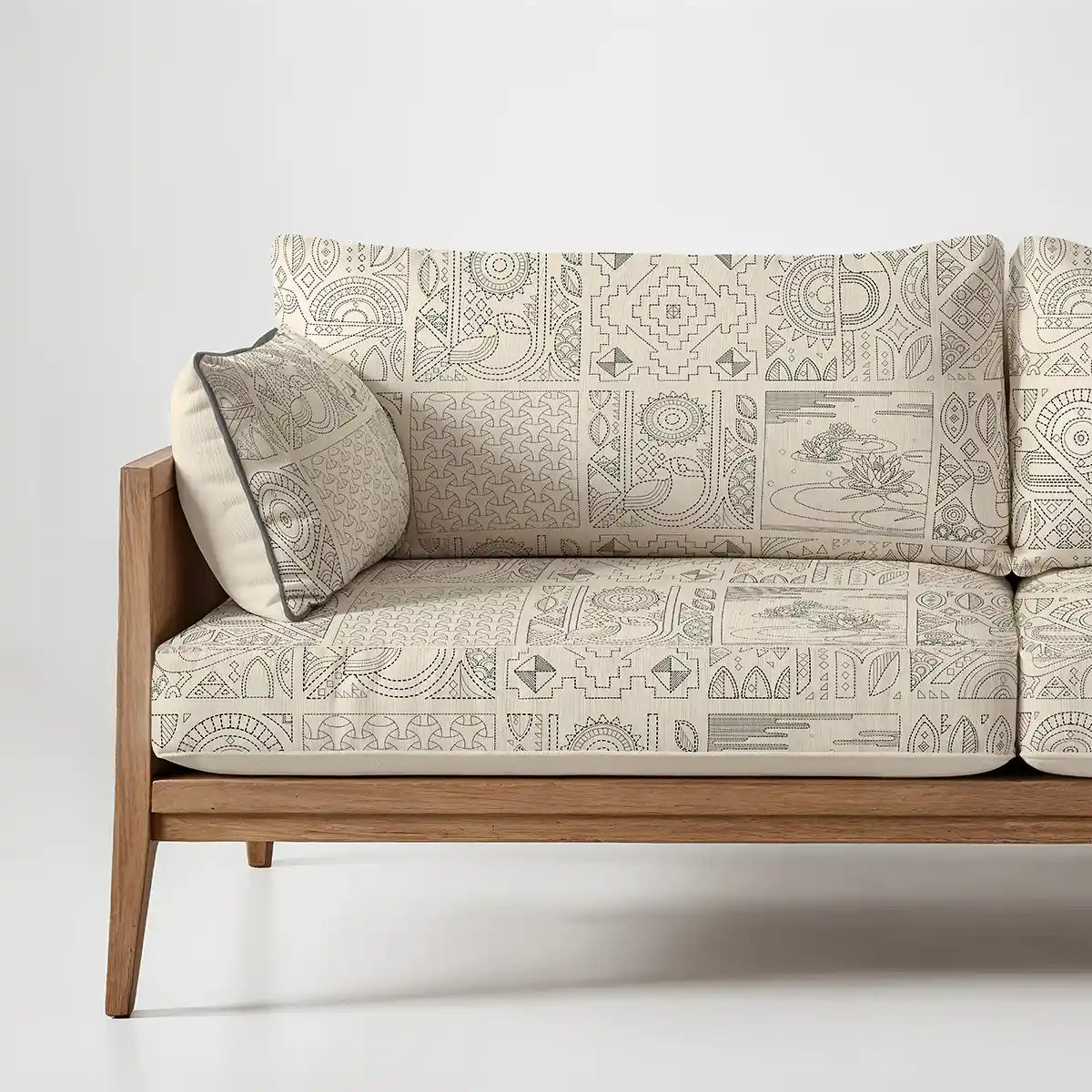
Kantha is quieter and older. It comes from Bengal, originally the art of layering worn saris and stitching them together with a running thread that created an all-over texture. The motifs — fish, elephants, the kalka paisley — had a looseness that came from a hand working from memory. The Kantha velvet upholstery fabric in ivory brings this into a denser ground: folk motifs on velvet that reads as embroidery from across the room, specific enough to reward a close look.
Sanjhi is a stencil art from Vrindavan — intricate cut-paper patterns made for temple courtyards, later carried into textile design. The Sanjhi Indian upholstery fabric in cream has that quality: fine-line repeats with a precision that looks considered without looking formal. On a sofa it works as the quietest option in this category — enough pattern to be interesting, restrained enough to live with for years.
Rooms where the walls carry a print from the Suneherii Indian heritage wallcovering collection pair naturally with fabrics from this group. Different scales of the same visual language — the kind of layering that looks intentional rather than matched.
Chinoiserie, European tapestry, and botanical art on a sofa
Three centuries of cross-cultural design that still reads correctly in a room.
Chinoiserie emerged in 17th and 18th-century Europe as a visual interpretation of Chinese art — pagodas, phoenixes, cranes, and peonies filtered through European craft traditions. It appeared on lacquered furniture, hand-painted wall panels, and embroidered bed hangings before moving to printed textiles. The result was a design language that balanced ornament with restraint: the motifs were complex, but the palette — usually blue-and-white or rust-and-gold — kept the whole thing readable.
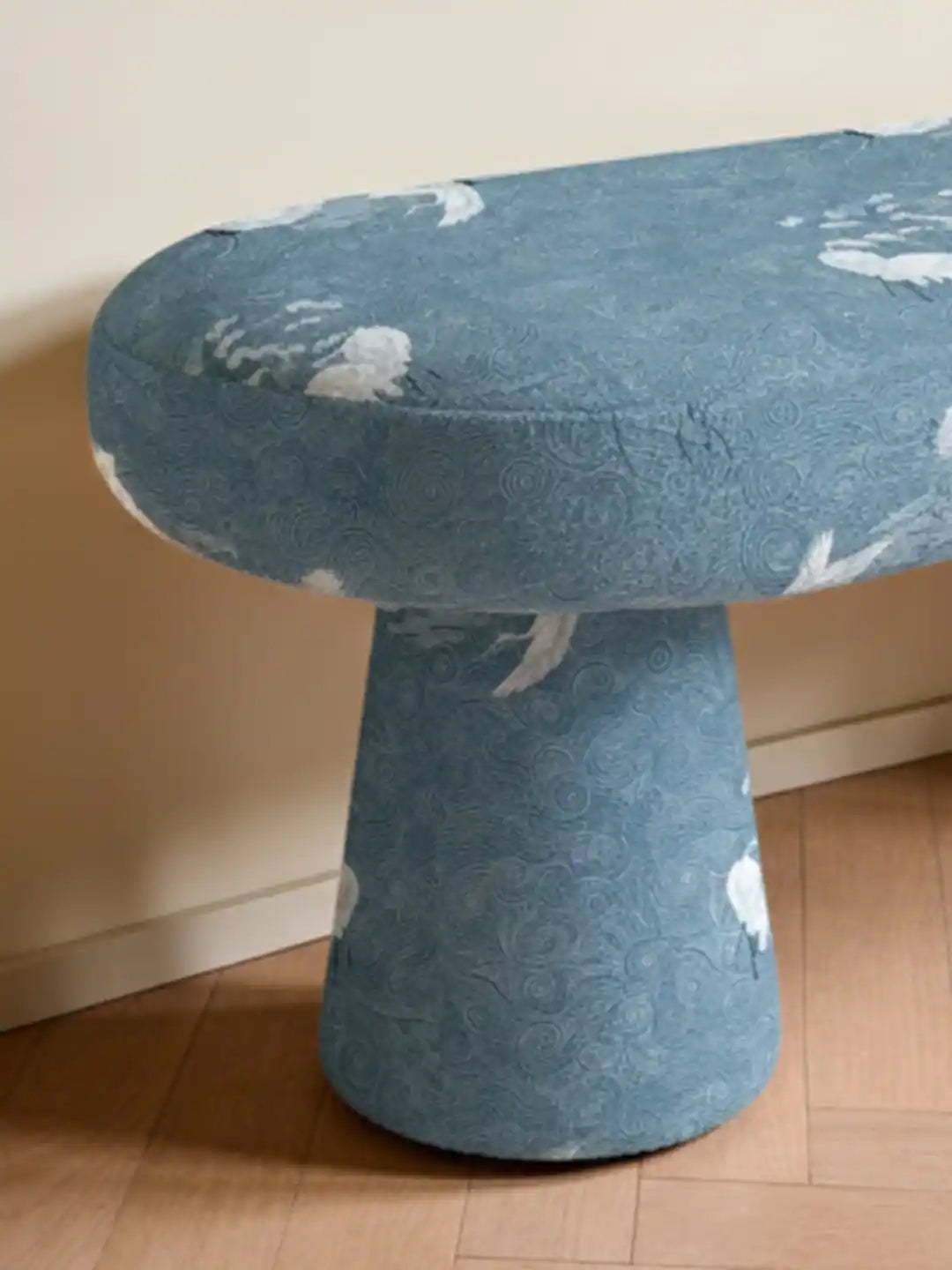
The Graceful Cranes upholstery fabric in white and blue draws directly from this lineage. Paired cranes among foliage, the print works on a single armchair as well as on a full three-seater run. For rooms that want the same tradition in a darker register, the Phoenix Chinoiserie in bottle green pairs well with wood, brass, and deep-coloured walls.
European tapestry design — Flemish and French in origin — has different proportions. The compositions are denser: botanical arrangements, birds among climbing vines, large-scale repeating panels. The European Tapestry upholstery fabric in beige carries this quality without the visual heaviness of the original woven form. It reads as depth rather than busyness — the kind of fabric that makes a room feel considered.
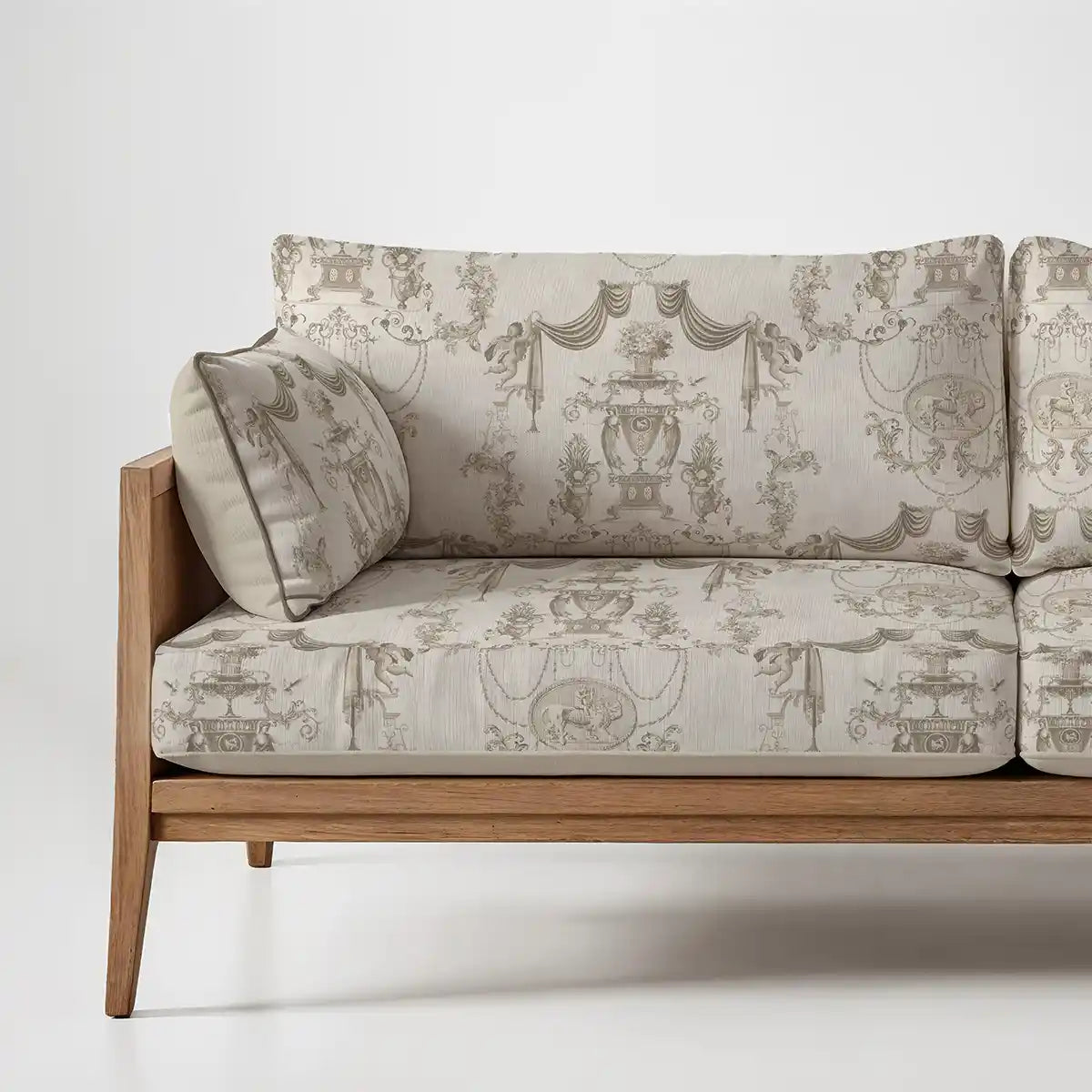
Both traditions connect naturally to the Amazora Chinoiserie and European wallcovering collection. Same design vocabulary at different scales — when they're used together, rooms have a coherent visual argument rather than a collection of unrelated decisions.
How patterned fabric actually works in a room
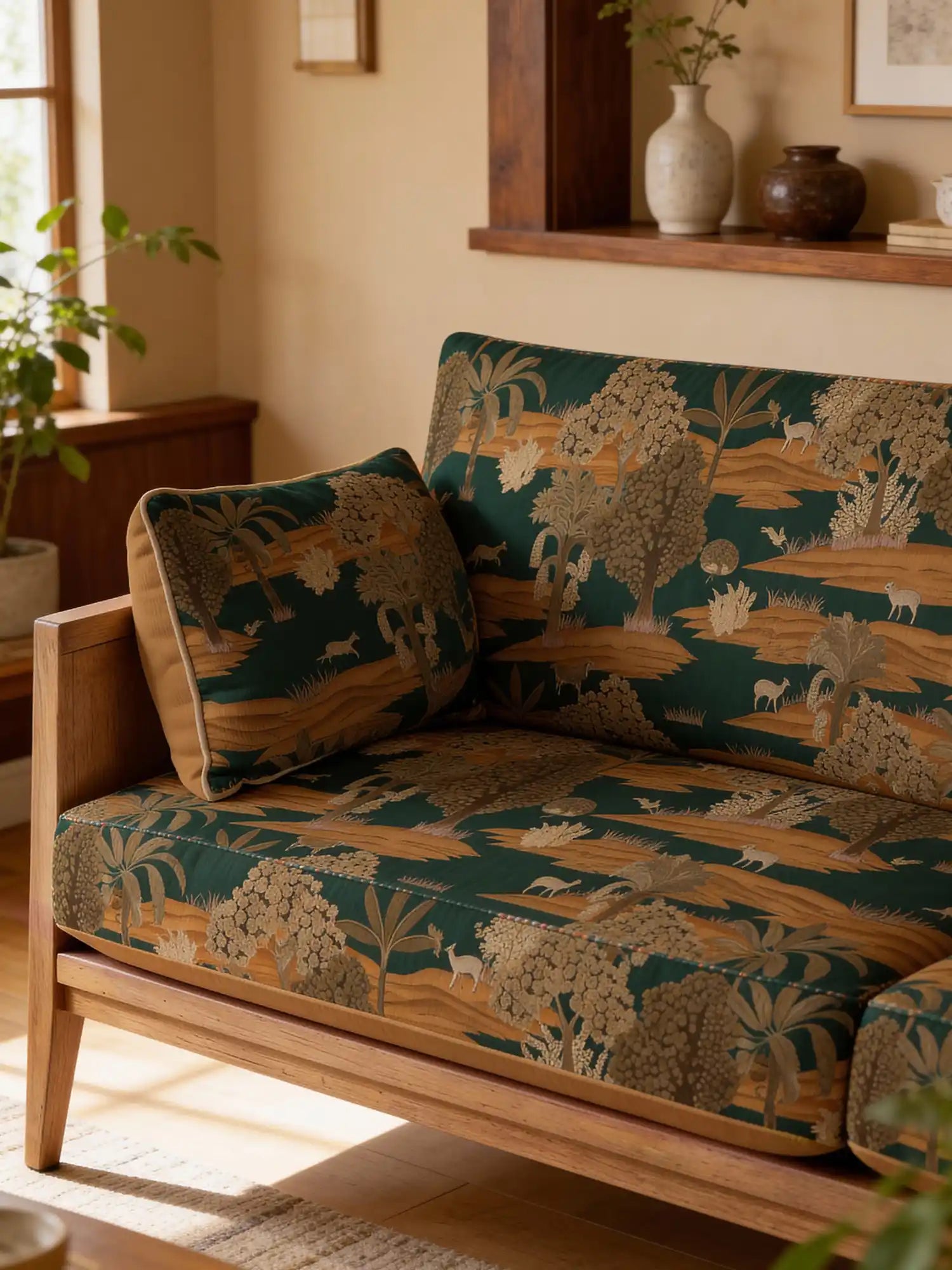
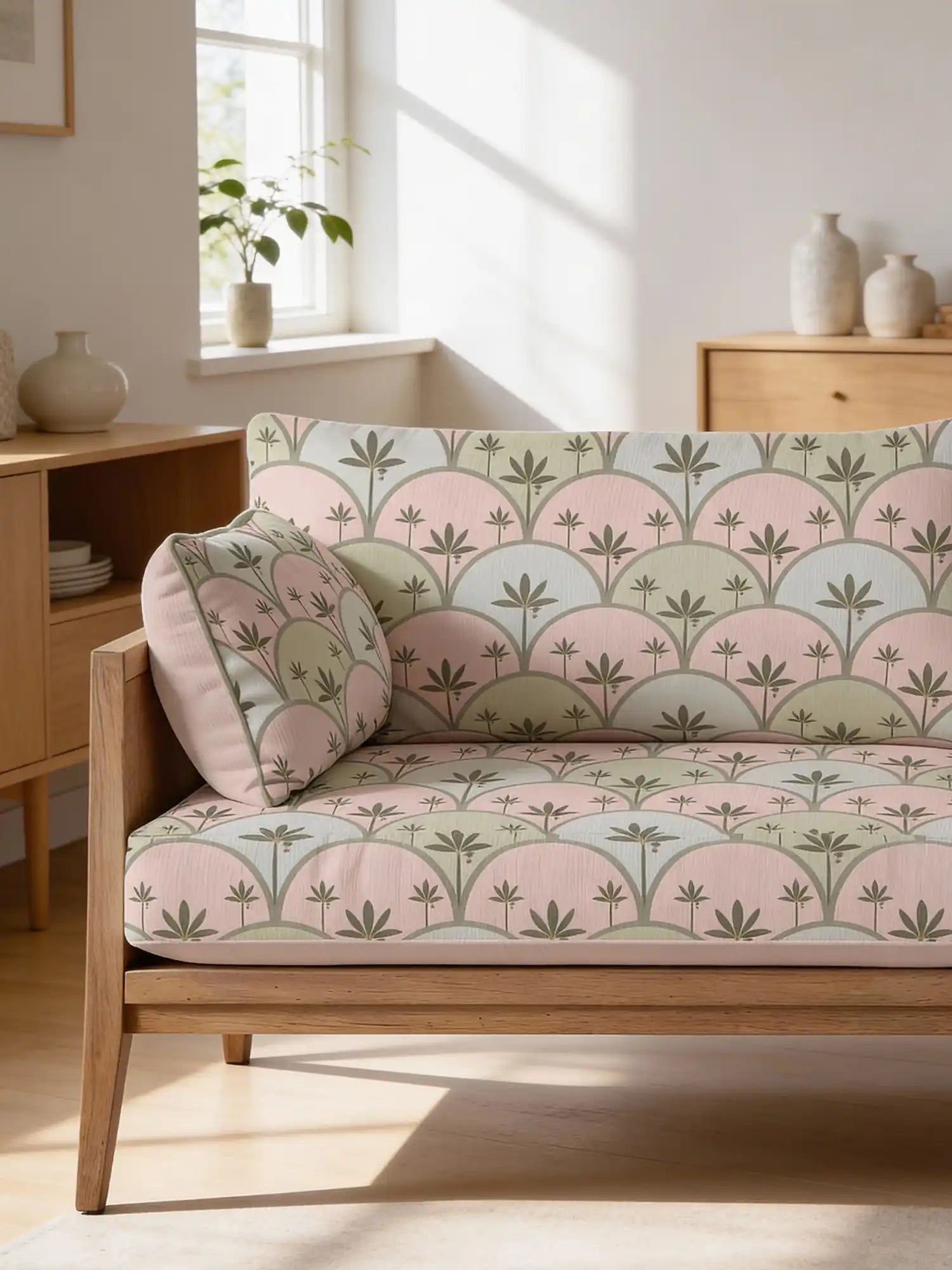
Scale before colour. Large-repeat prints — like the Ranthambore Forest fabric in green — need flat fabric planes to read correctly. A three-seater with minimal shaping, a daybed, or a generous armchair. On a heavily tufted or curved sofa, a smaller repeat or a geometric holds better because tufting interrupts the large-scale motif.
Contrast is not a risk. A patterned sofa against a plain wall is much easier to live with than most people expect. The print anchors the room; the unbroken wall gives it room to breathe. The harder pairing is two patterns at competing scales with no solid element between them.
The sofa doesn't need to match the chairs. Two Kanan Indian armchairs in pink and green beside a plain linen sofa read better than a three-piece suite in the same print. The eye needs contrast to appreciate either piece clearly.
The same print language extends naturally to the rest of the room. Prasanaakshi by Life n Colors cushion covers and curtain fabric share the same design vocabulary — so the sofa fabric becomes the starting point, and everything else coordinates from there.
The collection
All fabrics in the Life n Colors sofa and chair upholstery range are sold by the metre at ₹1,699, printed on a 137 cm-wide linen or velvet base, rated to 30,000 Martindale rubs — a professional-grade durability standard for furniture upholstery. In-stock fabrics leave the studio in one to three working days.
The 69 prints span Indian folk and classical traditions, Chinoiserie, European tapestry, botanical art, and wildlife design. Each one draws from a specific art tradition. If you want to see how a fabric handles in your own light before ordering metres, a sample swatch is the right first step.
The room is almost done. The sofa is the last thing.
The walls are sorted. The light is right. The floor is covered. And the largest single surface of fabric in the room is still dressed in the same shade of nothing it came with.
That's fixable. Browse the full printed upholstery fabric collection — or request a swatch and see the print in your own light before you decide.